Abhishek Bhandari Ph.D. Researcher
Working on post-recognition error correction for Indic Languages
PhD Researcher in Computer Science & Engineering

I am currently pursuing a PhD in Computer Science & Engineering at Indian Institute of Technology Jodhpur. My research focuses on Natural Language Processing and Computer Vision.

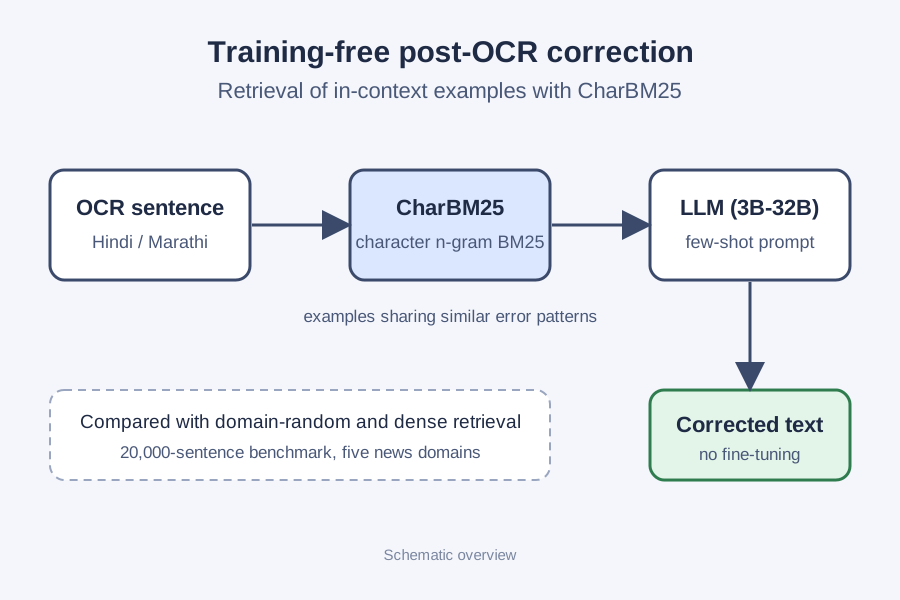
I design methods for contextual text error correction in Indic languages, multi-modal knowledge extraction, and low-resource learning.

Contextual Text Correction Indic Language Processing

Education
  • Indian Institute of Technology Jodhpur
    Indian Institute of Technology Jodhpur
    Computer Science & Engineering
    Ph.D. Student
    2020 - 2026 (expected)
  • University of Hyderabad
    University of Hyderabad
    M.Tech. in Information Technology
    2017 - 2019
  • Government Engineering College Ajmer
    Government Engineering College Ajmer
    B.Tech. in Information Technology
    2012 - 2016
News
2026
Our paper titled Post-ASR Correction for Low-Resource Rajasthani Language is accepted for publication in ACM Transactions on Asian and Low-Resource Language Information Processing
Jan 18
2025
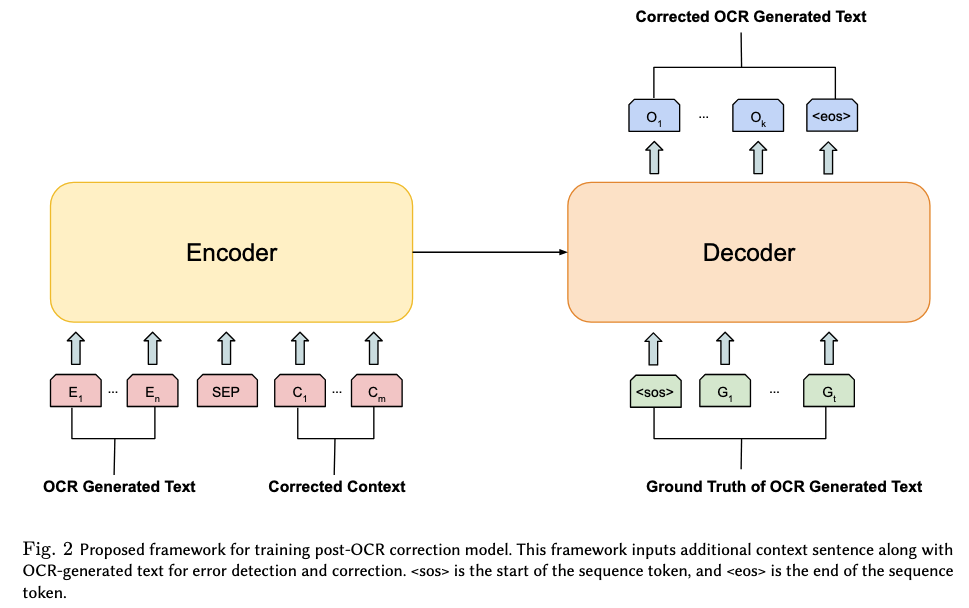
Our paper titled A Framework and Dataset for Contextual Post-OCR Correction is accepted for publication in ACM Transactions on Asian and Low-Resource Language Information Processing
Nov 22
Our paper titled Mind the (Language) Gap: Towards Probing Numerical and Cross-Lingual Limits of LVLMs is published in Proceedings of the 5th Workshop on Multilingual Representation Learning (MRL 2025)
Nov 09
Received travel grant for IndoML 2025
Oct 08
Selected Publications (view all )
Post-ASR Correction for Low-Resource Rajasthani Language

Abhishek Bhandari and Gaurav Harit

ACM Transactions on Asian and Low-Resource Language Information Processing (TALLIP)

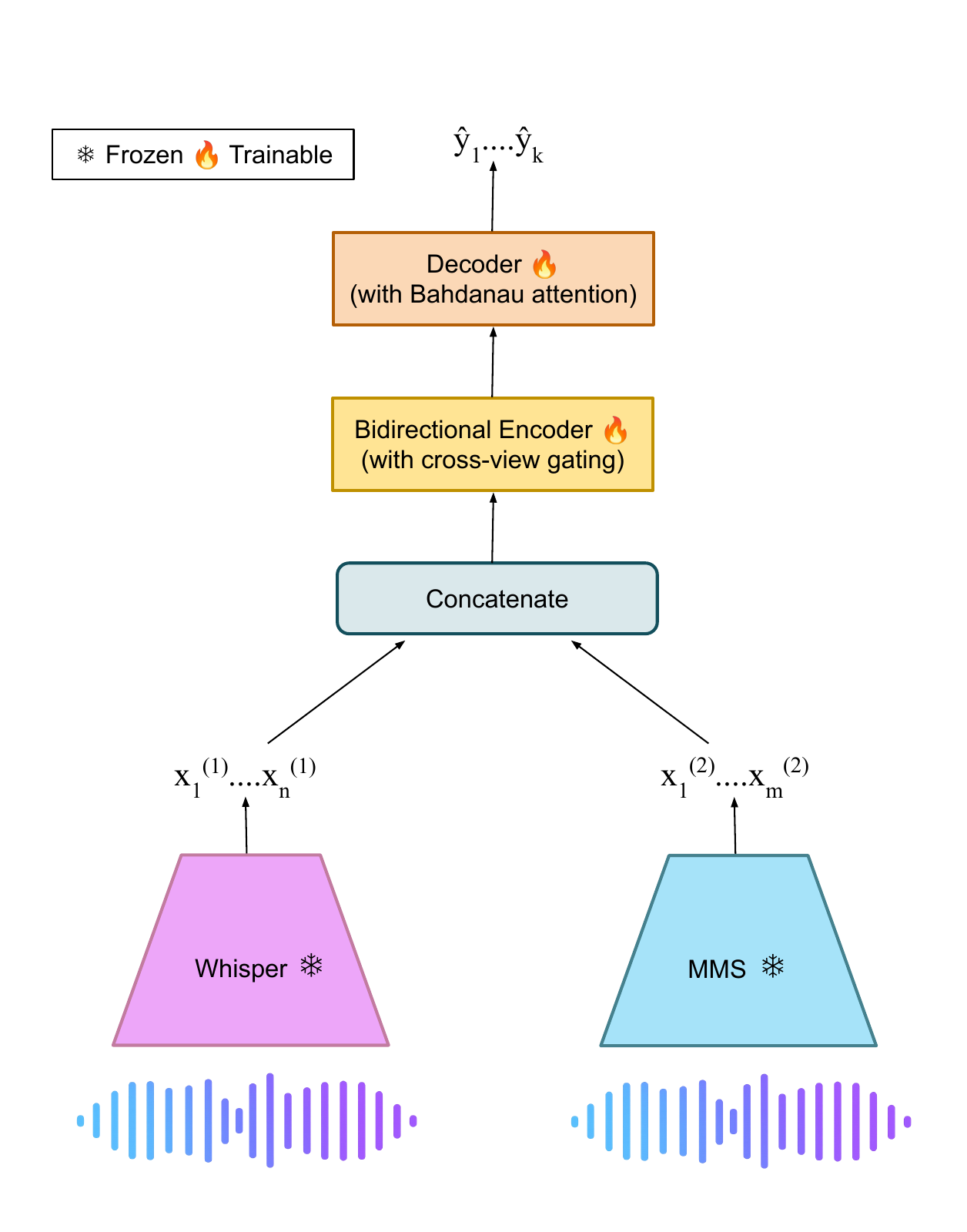
State-of-the-art multilingual Automatic Speech Recognition (ASR) models produce systematic errors when applied to lowresource languages like Rajasthani, for which they lack dedicated training data. This paper addresses this challenge by introducing a post-ASR correction framework that leverages the complementary error patterns in the outputs (termed as views) from two distinct models: Whisper-large-v3 and MMS-1B-All. We propose a multi-view1, character-level sequence-tosequence (Seq2Seq) model that uses a gated fusion mechanism to dynamically weigh information from the two ASR outputs. On a new benchmark created from the IndicTTS Rajasthani corpus, our gated model achieves a Character Error Rate (CER) of 7.86% and a Word Error Rate (WER) of 29.98%. This outperforms the best single-view baselines (8.01% CER and 30.33% WER), simple multi-view concatenation (8.21% CER and 30.05% WER), as well as Llama-3.2-3B and mBART-50-large, both fine-tuned on Whisper and MMS inputs. It also surpasses powerful Large Language Models (LLMs) like GPT-4o and Gemini 2.5 Pro in a zero-shot setting. This work establishes the first baseline for post-ASR correction in Rajasthani, demonstrating that a compact, specialized model is more effective than general-purpose LLMs for this targeted, low-resource task.

Post-ASR Correction for Low-Resource Rajasthani Language

Abhishek Bhandari and Gaurav Harit

ACM Transactions on Asian and Low-Resource Language Information Processing (TALLIP)

State-of-the-art multilingual Automatic Speech Recognition (ASR) models produce systematic errors when applied to lowresource languages like Rajasthani, for which they lack dedicated training data. This paper addresses this challenge by introducing a post-ASR correction framework that leverages the complementary error patterns in the outputs (termed as views) from two distinct models: Whisper-large-v3 and MMS-1B-All. We propose a multi-view1, character-level sequence-tosequence (Seq2Seq) model that uses a gated fusion mechanism to dynamically weigh information from the two ASR outputs. On a new benchmark created from the IndicTTS Rajasthani corpus, our gated model achieves a Character Error Rate (CER) of 7.86% and a Word Error Rate (WER) of 29.98%. This outperforms the best single-view baselines (8.01% CER and 30.33% WER), simple multi-view concatenation (8.21% CER and 30.05% WER), as well as Llama-3.2-3B and mBART-50-large, both fine-tuned on Whisper and MMS inputs. It also surpasses powerful Large Language Models (LLMs) like GPT-4o and Gemini 2.5 Pro in a zero-shot setting. This work establishes the first baseline for post-ASR correction in Rajasthani, demonstrating that a compact, specialized model is more effective than general-purpose LLMs for this targeted, low-resource task.

A Framework and Dataset for Contextual Post-OCR Correction

Abhishek Bhandari and Gaurav Harit

Accepted in ACM Transactions on Asian and Low-Resource Language Information Processing (TALLIP)

This paper presents a framework and dataset for contextual post-OCR correction to improve text quality in low-resource and noisy OCR settings.

A Framework and Dataset for Contextual Post-OCR Correction

Abhishek Bhandari and Gaurav Harit

Accepted in ACM Transactions on Asian and Low-Resource Language Information Processing (TALLIP)

This paper presents a framework and dataset for contextual post-OCR correction to improve text quality in low-resource and noisy OCR settings.

Mind the (Language) Gap: Towards Probing Numerical and Cross-Lingual Limits of LVLMs

Somraj Gautam, AS Penamakuri, Abhishek Bhandari, Gaurav Harit

Proceedings of the 5th Workshop on Multilingual Representation Learning (MRL 2025)

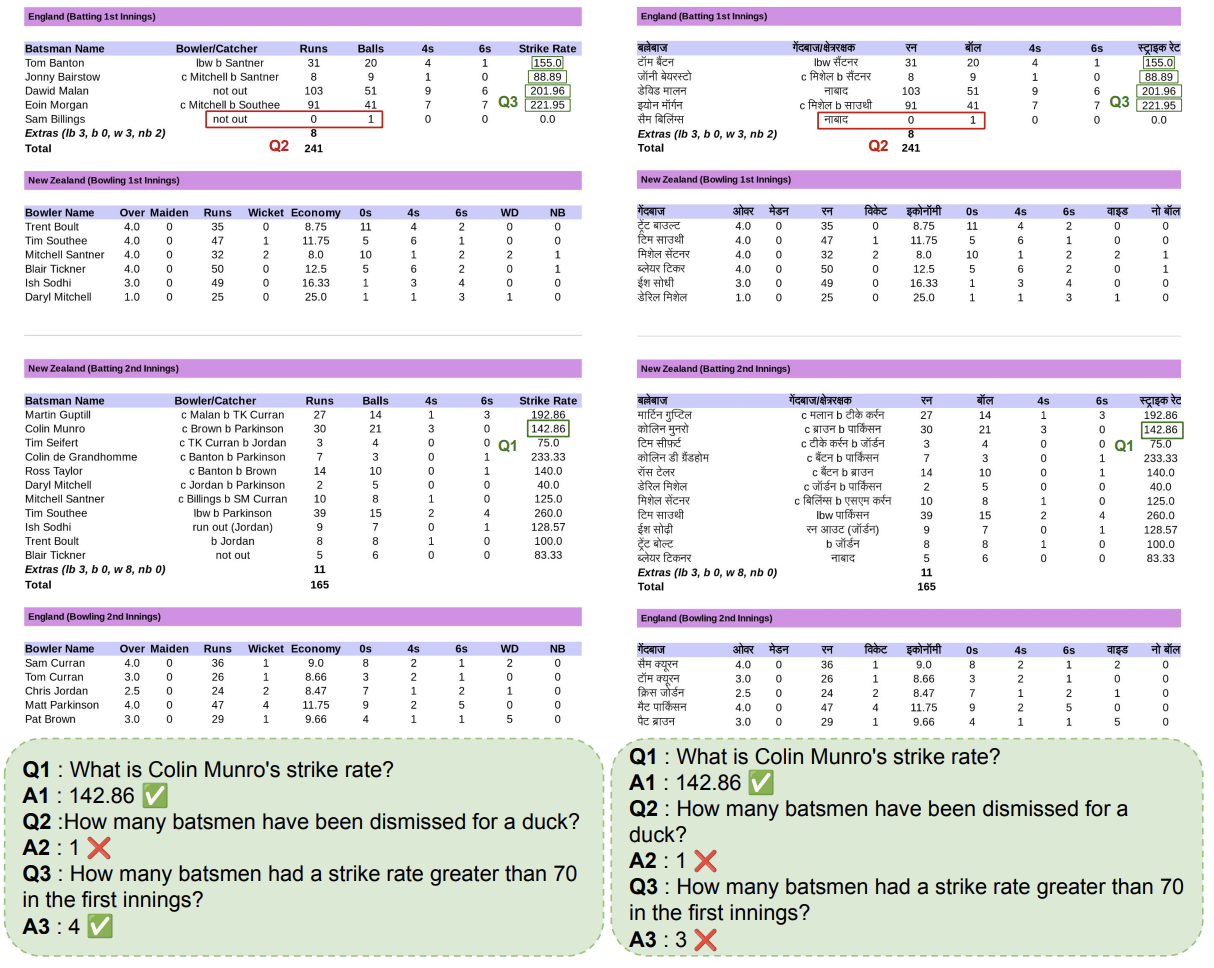
This paper introduces MMCRICBENCH-3K, a benchmark for Visual Question Answering on cricket scorecards designed to evaluate large vision-language models on complex numerical and cross-lingual reasoning over semi-structured tabular images. Empirical results show that state-of-the-art models struggle with structure-aware numerical reasoning and cross-lingual generalization.

Mind the (Language) Gap: Towards Probing Numerical and Cross-Lingual Limits of LVLMs

Somraj Gautam, AS Penamakuri, Abhishek Bhandari, Gaurav Harit

Proceedings of the 5th Workshop on Multilingual Representation Learning (MRL 2025)

This paper introduces MMCRICBENCH-3K, a benchmark for Visual Question Answering on cricket scorecards designed to evaluate large vision-language models on complex numerical and cross-lingual reasoning over semi-structured tabular images. Empirical results show that state-of-the-art models struggle with structure-aware numerical reasoning and cross-lingual generalization.

TabComp: A Dataset for Visual Table Reading Comprehension

Somraj Gautam, Abhishek Bhandari, Gaurav Harit

Findings of the Association for Computational Linguistics: NAACL 2025

This paper introduces TabComp, a dataset for visual table reading comprehension. The dataset is designed to advance research in understanding and extracting information from tables in documents.

TabComp: A Dataset for Visual Table Reading Comprehension

Somraj Gautam, Abhishek Bhandari, Gaurav Harit

Findings of the Association for Computational Linguistics: NAACL 2025

This paper introduces TabComp, a dataset for visual table reading comprehension. The dataset is designed to advance research in understanding and extracting information from tables in documents.

Reversible data hiding using multi-layer perceptron based pixel prediction

A Bhandari, S Sharma, R Uyyala, R Pal, M Verma

Proceedings of the 11th International Conference on Advances in Information Technology 2020

This paper presents a novel approach for reversible data hiding using multi-layer perceptron for pixel prediction. Reversible data hiding is a technique that allows the original cover media to be perfectly restored after the hidden data has been extracted.

Reversible data hiding using multi-layer perceptron based pixel prediction

A Bhandari, S Sharma, R Uyyala, R Pal, M Verma

Proceedings of the 11th International Conference on Advances in Information Technology 2020

This paper presents a novel approach for reversible data hiding using multi-layer perceptron for pixel prediction. Reversible data hiding is a technique that allows the original cover media to be perfectly restored after the hidden data has been extracted.

All publications